Building an ECL Platform: The Technology Architecture Banks Will Need
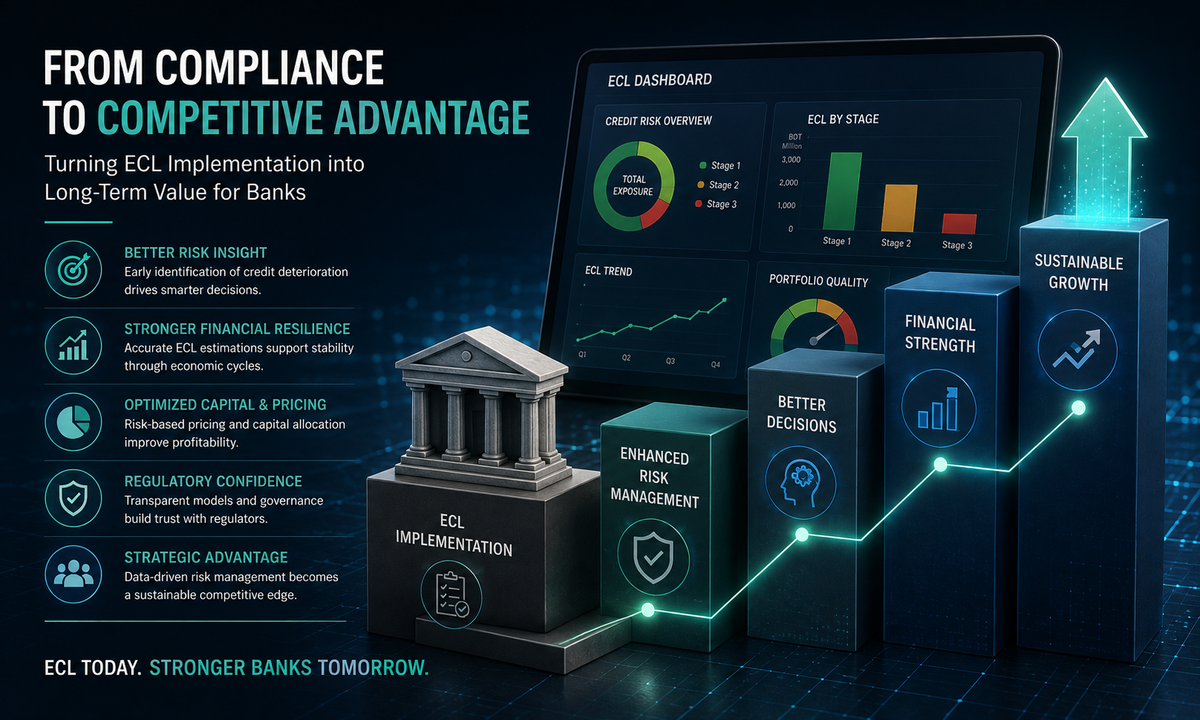
A successful ECL implementation cannot depend on scattered spreadsheets.
The framework requires regular data collection, model execution, scenario analysis, calculation, approval, reporting, and auditability.
That means banks need a technology architecture that can support the full ECL lifecycle.
Why Excel is not enough
Excel may be useful during early analysis or pilot testing. But full-scale ECL implementation requires reliability, repeatability, control, and audit trail.
A manual process creates risks:
- calculation error
- version mismatch
- missing approval history
- inconsistent assumptions
- weak access control
- difficult audit review
- slow reporting cycle
For a bank with thousands or millions of loan accounts, ECL needs automation.
Core components of an ECL platform
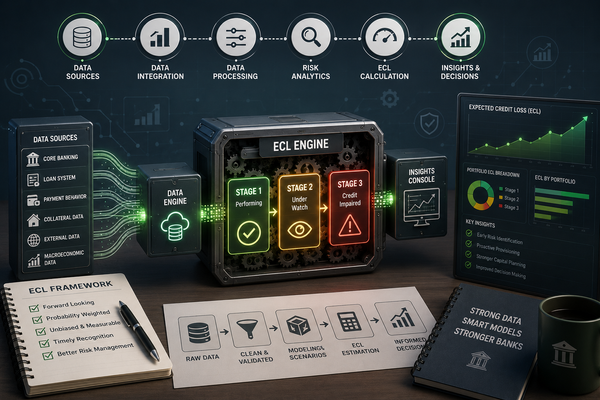
A practical ECL platform should have several layers.
1. Source system integration
ECL data comes from many systems.
These may include:
- Core Banking System
- Loan Origination System
- CRM
- Collateral Management System
- Treasury System
- Trade Finance System
- Collection System
- General Ledger
- Credit Bureau
- External macroeconomic data source
The platform must collect data from these systems regularly.
2. Data integration layer
This layer extracts, transforms, and loads data into a central repository.
It performs:
- data mapping
- validation
- cleansing
- duplicate checking
- missing value identification
- standardization
- reconciliation
For example, borrower ID, loan account number, customer segment, collateral ID, and facility limit must be properly mapped.
3. ECL data warehouse
This is the central data foundation.
It stores clean and structured data required for ECL.
It should contain:
- borrower master data
- facility data
- repayment history
- overdue history
- collateral data
- default history
- recovery history
- rating history
- macroeconomic data
- staging history
This warehouse supports both calculation and reporting.
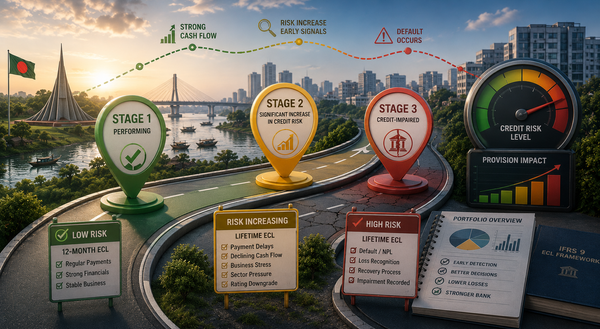
4. Staging engine
The staging engine determines whether a loan belongs to Stage 1, Stage 2, or Stage 3.
It applies business rules such as:
- days past due
- significant increase in credit risk
- rating downgrade
- restructuring flag
- watchlist flag
- default status
- qualitative risk indicators
The staging engine must be configurable because banks may refine rules over time.
5. Risk model engine
This engine calculates or applies model outputs for:
- PD
- LGD
- EAD
It may use statistical models, rule-based models, scorecards, or hybrid approaches depending on data maturity.
The model engine should support:
- segmentation
- model versioning
- calibration
- validation
- approval workflow
- override management
6. Scenario engine
ECL must consider forward-looking economic scenarios.
A scenario engine allows banks to define:
- baseline scenario
- optimistic scenario
- pessimistic scenario
- stress scenario
Each scenario may include assumptions for:
- GDP growth
- inflation
- interest rate
- exchange rate
- sector performance
The engine then applies scenario weights to calculate probability-weighted ECL.
7. ECL calculation engine
This is where the final expected credit loss is calculated.
The engine combines:
- exposure data
- stage
- PD
- LGD
- EAD
- discount factor
- macroeconomic scenario weights
It generates:
- account-level ECL
- customer-level ECL
- product-level ECL
- portfolio-level ECL
- branch-level ECL
- sector-level ECL
8. Reporting and dashboard layer
A strong platform should provide dashboards for different users.
For Risk Team
- portfolio risk movement
- stage migration
- high-risk segments
- early warning indicators
For Finance Team
- provision summary
- GL posting support
- month-end reports
- variance analysis
For Management
- sector-wise ECL
- capital impact
- trend analysis
- scenario comparison
For Regulators and Auditors
- methodology report
- audit trail
- data lineage
- calculation breakdown
- approval history
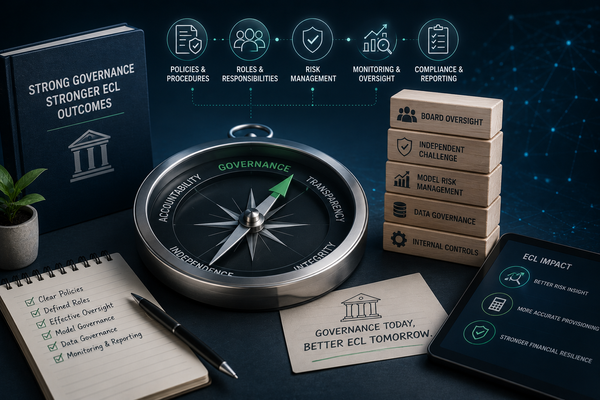
9. Governance and audit trail
Every calculation must be traceable.
The system should record:
- who uploaded data
- which model version was used
- which assumptions were applied
- who approved the result
- what changes were made
- why an override was applied
This is critical for audit confidence.
Implementation approach
Banks should not attempt to build everything at once.
A practical approach can be phased.
Phase 1: Readiness and data assessment
Identify data sources, gaps, owners, and system limitations.
Phase 2: Prototype ECL model
Build initial PD, LGD, EAD logic and test on selected portfolios.
Phase 3: Platform integration
Connect source systems, automate data pipelines, and build calculation workflow.
Phase 4: Parallel run
Compare old provisioning results with ECL results.
Phase 5: Full implementation
Move to production with governance, reporting, and audit controls.
The ECL platform of the future is not just a compliance system.
It is the risk intelligence layer of the modern bank.
It connects data, models, scenarios, workflows, and reporting into one controlled ecosystem.
For banks preparing for IFRS 9, technology readiness will be just as important as regulatory understanding.